All posts by Gwen Minor

Stories From the Ancient World

Ancient World Now:Andromache & Hector

Click here for direct link to audio Episode #21.

Click here for previous episodes.

The parting of Hector and Andromache ranks as one of the most touching scenes in literary history, if not the most. In Book 6 of The Iliad, before going on to the battlefield for the last time, Prince Hector says goodbye to his tearful wife, Andromache, and their son Astyanax. When Hector approaches, the baby screams with fear at the sight of the bronze helmet with its horsehair crest. Both mother and father burst into laughter at the sight. The deep tragedy of their situation is cut through with this stroke of humanity.

Homer is not on the side of the Greeks or on the side of the Trojans. Homer is on the side of humanity and wants us to feel the pain of war. Andromache, for thousands of years, has been the epitome of the loving wife. Her sad plea for Hector to remain with them is for naught. He must go out to fight. Though she has lost both parents and all of her brothers to war, Andromache has two more loved ones to lose. Hector, of course, is killed in a mad rage by Achilles, and Astyanax is ripped from his mother’s arms and thrown from the walls of Troy by the Greek soldiers.

The most touching moments in The Iliad bloom up from scenes involving the Trojan royal household. Walk with me through Book 6 & Book 22 of The Iliad to sample the literary techniques Homer uses to take us to the war inside the hearts and minds of the non-soldiers, from the dutiful maidservant to playboy Prince Paris. Have tissues handy!
Ancient World Now:Wolfgang Petersen’s Troy

Click here for direct link to audio Episode #20.

Click here for previous episodes.

So many of you have asked me: What do you think of Wolfgang Petersen’s film Troy?

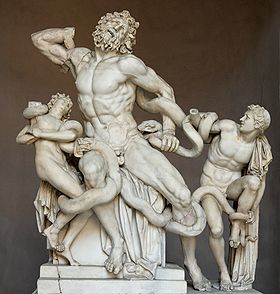
Well, filmmakers always tamper with characters and situations from the original story, and Petersen is no exception. But I ask where,  in Homer’s name, is the real tale of the death of Ajax? And where, indeed, is Laocoon, the great seer, who with his sons was dragged to his watery death by a sea serpent when he tried to tell King Priam that the wooden horse would bring about the end of Troy?

The “greatness” of great story lies in the portrayal of the depth of human character. That a director has 180 minutes in which to show the scope of human triumph and tragedy is unrealistic. One must go to the source of these great stories in order to learn from them.

And how do we as humans display character? By the small things we do each day. In times of peace, it might be something as simple as nodding to the driver who yields their right of way. Or by patiently accepting the customer service routine from eager teen clerks because they are in training. And in times of crisis and war, we might reveal our character by resolving not to look at images of humiliation, or by remaining speechless in a time of sorrow and shame. These minor actions and inactions reveal the complexities of the human mind, heart, and spirit in ways, that in the rush of our lives, we often fail to see. It is precisely the lack of these simple human gestures that keeps modern film epics from attaining greatness. Wolfgang Petersen’s Troy is by its very nature crippled in its attempts. But, hey, using technology to create the image of the “launch of a thousand ships” was pretty cool! And then Brad Pitt as Achilles, well, what can I say?

Listen to this week’s podcast to find out how Petersen’s film differed from the original epic. Enjoy!

Ancient World Now:The Oracle at Delphi

Click here for direct link to audio Episode #19.

Click here for previous episodes.

The very mention sends classicists into ecstasy! Reverence. Devotion. And lots of fun! Travelling great distances—getting your fortune told—checking out the Pythia on her little stool—maybe enjoying the Delphic games—even taking a plunge in the Delphic swimming pool!

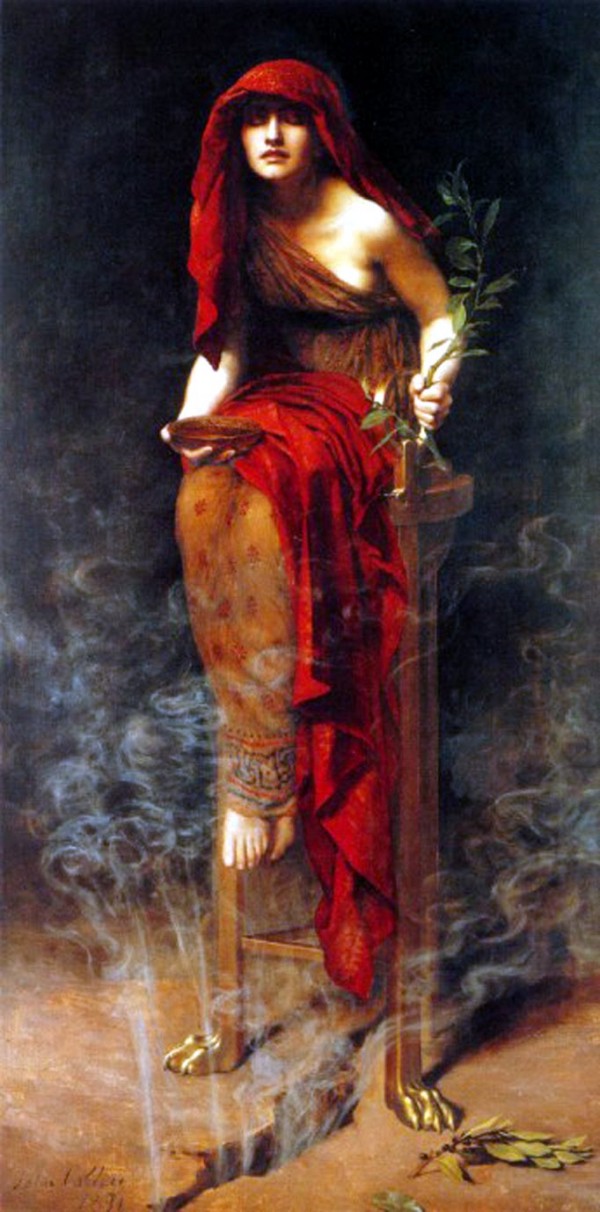
At the time of Pliny the Elder, there were as many as 3,000 statues on the grounds and scores of specially-built treasuries by individual city-states to hold the vast and assorted offerings (read:TREASURE!!!). But plunder over the centuries reduced Delphi to ruins. In fact, it was said that the mad Roman emperor Nero had 500 bronze statues carried off! Those Romans—you can dress them up, but you can’t take them out! The painting to the right is by the Pre-Raphaelite painter John Collier and depicts the Pythia, in her romanticized younger self. In reality, the Pythia was an older woman of wisdom especially chosen for having led a “blameless life”.

Special thanks to my friend Sydney, for letting me know that there is a beer called Pliny the Elder! Northern California’s Russian River Brewing Company brews it yearlong, while once a year, for a very limited time, they make Pliny the Younger available! The elder Pliny died in the fiery aftermath of the eruption of Mt. Vesuvius. His nephew, the younger Pliny, let us know all the details, as he was a writer. Cool stuff, too! Very readable.

Enjoy today’s episode on the oracle at Delphi!

Ancient World Now: The Mysteries of Dionysus

Click here for direct link to audio Episode #18

Click here for previous episodes.

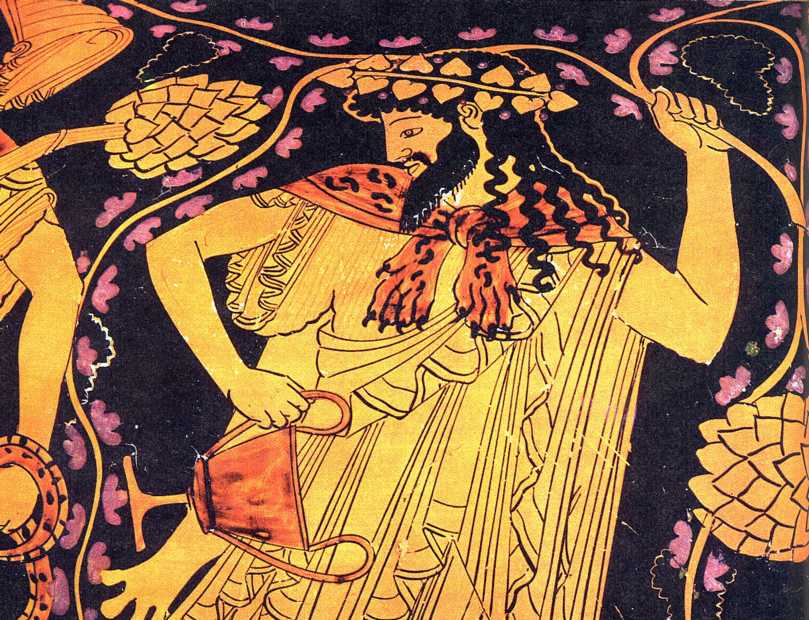
Woo hoo!!! Can’t you just hear Dionysus jamming to his midnight tunes in this depiction on the side of a vase? As the lads in AC/DC stated so elegantly back in the ’80’s: “For those about to rock, we salute you!”

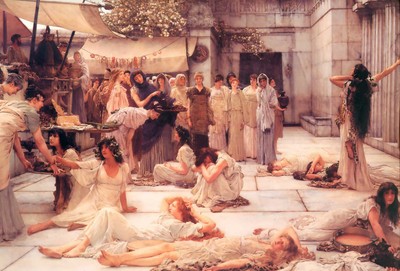
Euripides’ play The Bacchae details some of the outrageous night-time shenanigans and strange rituals of the maenads, the female devotees of Dionysus, the god of wine. This painting by Sir Lawrence Alma-Tadena shows the maidens, all tuckered out after a night of revelry.

Listen to today’s podcast to find out about the myth of Dionysus.

Ancient World Now:Isis

Click here for direct link to audio Episode #17.

Click here for previous episodes.

Come by the San Francisco Main Library this Thursday & Friday for my Shakespeare Kidquake event. On Thursday from 11:15-noon a 5th grade class does A Midsummer Night’s Dream. On Friday from 3-5 pm, a bunch of teens do Theatre Terminate, my Shakespeare death scenes performance. Stop in to say hi!

“Oh mighty Is-is-is-isssss!” A cool 70’s morning show that I used to watch. Ah, the good old days. Lounging around on a Saturday morning. And guess what! Our 70’s heroine was a teacher who transformed into Isis to fight the forces of evil! Maybe she was my inspiration! “You will soar as the falcon soars!” Except that looks like a raven.

My favorite part of Isis worship is the nilometer, for the waters of the Nile were sacred. In fact, a jug of water from the Nile was included in their rituals, no matter how far from Egypt the devotees were. Nilometers, measured sea levels & were built in port cities around the Mediterranean to determine sea levels. Very cool old school mechanical instrument to open the season of navigation in the spring—and the annual flooding of the Nile River. This flooding was essential for the growing of grain along the banks of the Nile. Egypt was famous in the ancient world for its grain production and was the chief factor in Rome’s subjugation of Egypt. Without Egypt’s grain supply, the Roman empire would have collapsed and mass starvation would have occurred.

The nilometers were made obsolete when the Nile was dammed in the 20th century. Ah, progress….

Here’s our real honest-to-goodness Isis:
Love that headdress!

Ancient World Now: Mithraism-Astronomy Behind the Worship

Click here for direct link to audio Episode #16.

Click here for previous episodes.

Twinkle, twinkle, little star….. Humans have gazed at the stars since the beginning of time. Have you ever wondered how the concept of the universe has changed over time? Babylonians, ancient Chinese, Greeks, Romans, Aztec cultures all had their own view of the universe. Mithraic iconography abounds in astronomical symbolism.

The Greco-Roman world was a geocentric world and the axis of the earth and the celestial sphere were thought to be stationary. But in 125 B.C., Hipparchus rocked the ancient world when he discovered the precession of the equinoxes.

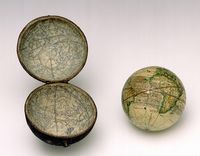
On the right is a pocket globe from 1772. The inside lining of its hinged case details the constellations, including the latest discoveries of the time, Edmond Halley’s celestial maps of the southern hemisphere. To see this fabulous object “in person”, you have to visit the National Maritime Museum in London, England. And to see the Southern Cross, you have to travel to Antarctica, where my husband worked for many years. Check out David’s blog to get a
taste of “The Ice”!

And check out this week’s audio episode to find out how in tarnation all this relates to the ancient world!

Ancient World Now: Mithras & Mithraism

Click here for direct link to audio Episode #15.

Click here for previous episodes.

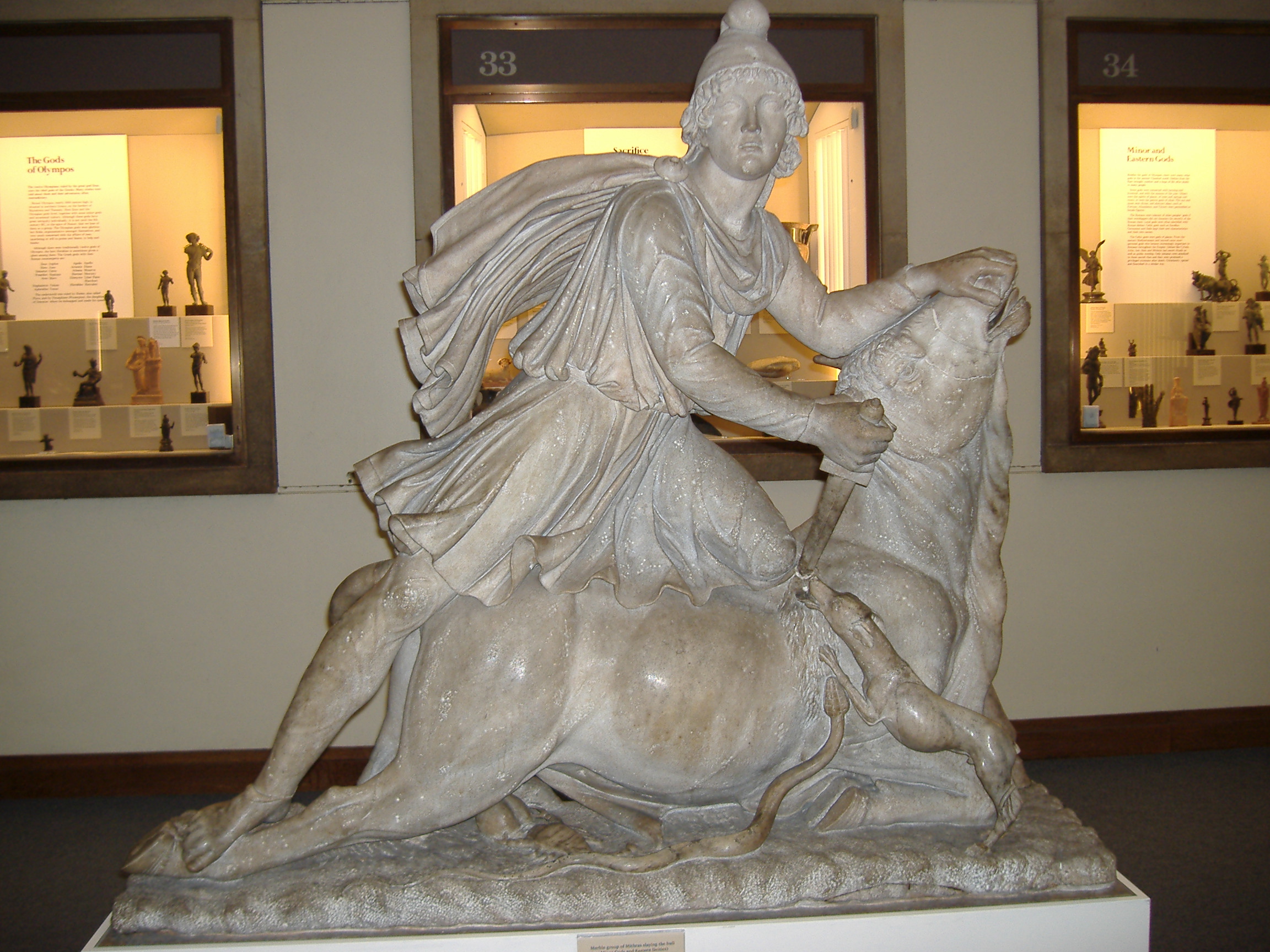
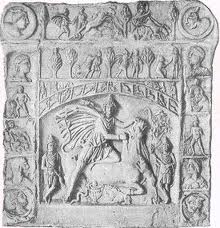
Surely you’ve seen the statues. The Tauroctony. This one is from the British Museum. A good-looking guy with longish hair, wearing a short tunic, a flowing cape, and a Phrygian cap. He looks nice enough, but he’s plunging a dagger into the neck of a bull that appears to have been minding his own business! My word! What’s up with that? And then you’ve got this little dog and the scorpion and the crab and the snake all hanging out with the bull. Who can figure that out?

Well, as archaeology is a fairly young discipline, we’ve got some catching up to do. The deets about Mithraism are still being catalogued by our brothers & sisters “in the field”. To get a sense of the vastness of Mithraic worship, there are at least 190 known Mithraea around the Roman world and a mere 1/10th of them have been excavated. Fifteen Mithraea have been located beneath Catholic churches in Rome.

But there’s a lot that we may never know or understand, no matter how long or hard archaeologists work. A true “mystery religion”, believers were bound to secrecy on pain of death, so no written evidence exists at this time to describe their rituals and practices. One Mithraic practice we are certain of is that on occasion a real bull was slaughtered above the vaulted underground temple site and the blood of the animal showered down over a select individual. Egads! Let me outta here!  

We also know that it was primarily a religion of the Roman military. Over the centuries, Mithraism worked its way up from the lower classes into the Roman elite. Mithraism took hold in Imperial Rome around the 2nd century CE after the Emperor Commodus was initiated into its mysteries. Freed slaves achieved wealth and status, and veterans of the military retired to Rome itself or some province of the empire and lived out their days practicing their religion. Ultimately, pagan religions were outlawed by Theodosius at the end of the 5th century and Mithraism died out.

Enjoy today’s episode. Next week I detail some of the recent theories on the astronomy behind Mithraism.

Homework for this week: read an encyclopedic entry for astronomy to get the basic concepts down before next week’s episode.

Litquake 2010

Once again, I’ll be doing a workshop for kids at this year’s Litquake. Kidquake & Teenquake are held at the San Francisco
Public Library’s Main branch at the Civic Center. Here are the deets for my Teenquake event:

THEATRE TERMINATE
Has Shakespeare gone mad? Everybody dies in a tragedy, so join the mayhem in this death scenes workshop.
Check it all out with Gwen Minor at www.gwenminor.com
Here is a challenge for those of you who have done Shakespeare with me. Match each Shakespeare character with his or her final words.

Desdemona “As sweet as balm, as soft as air, as gentle,—O Antony! —Nay, I will take thee too. What should I stay—“
Julius Caesar “O happy dagger! This is thy sheath; there rust, and let me die.”
Romeo “Farewell: commend me to my kind lord: O, farewell!”
Cleopatra “The rest is silence.”
Juliet “Mine & my father’s death come not upon thee, nor thine on me!”
Hamlet “Here’s to my love! O true apothecary! Thy drugs are quick. Thus with a kiss I die.”
Laertes “Et tu, Brute! Then fall, Caesar.”

Ancient World Now: The Eleusinian Mysteries

Click here for direct link to audio podcast Episode #14.

Click here for previous episodes.

Part II in a five-part series on religions of the ancient world.

This ancient tale is the basis of the Eleusinian Mysteries honoring the grain goddess Demeter and her daughter, Persephone.

One bright spring morning, when the dew was still clinging to the flower petals and the green blades of grass, the lovely Persephone, daughter of Demeter, was making her rounds of the fields. Persephone had a special duty as the daughter of Demeter. It was her job to paint the flowers in the springtime. So, with her paintpot she wandered from blossom to blossom, choosing the colors that were most pleasing to her.

Her mother, Demeter, was busy making things grow, and did not notice that her daughter had wandered away from her side. With great delight, Persephone mixed the colors of the sky with the colors of the grape to get just the right shade of lavender, when suddenly, the Earth ripped open a chasm right at her feet and from the depths charged a great chariot pulled by two black stallions. Driving the chariot was Hades, King of the Underworld, and he snatched Persephone up in his arms and dove back down to the depths of his dark kingdom.

Demeter heard the cries of her beloved daughter, and raced to the sounds of the fading voice. By the time she reached the spot, there was no trace of what had happened there. Demeter cried aloud for her girl, but there was silence. She searched field and forest day and night, carrying a flaming torch to light her way. But Persephone was nowhere to be found.

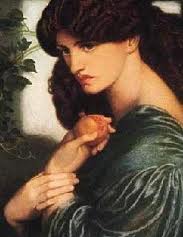
This famous painting by Dante Gabriel Rossetti of our girl gives a clue to her tale in the red pomegranate she is holding.  Listen to this week’s podcast to find out what happens to Persephone! Enjoy!

Ancient World Now: The Pantheon of Gods & Goddesses

Click here for direct link to audio Episode #13.

Click here for previous episodes.

HAPPY LABOR DAY!

It is important to note that the Roman Empire could not have existed without the free labor of those forced into slavery. The island of Delos was the hotspot for slave auctions. There, you could buy slaves from all over the empire to: keep your books on your farm in the country, take dictation in your consul meetings, tutor your first-born son, protect your house, fix your hair and make-up in the morning, manage your villa in Gaul, raise your children, cook the day’s meal, beat & torture your other slaves when they got out of line, and remain so faithful that he kills himself when you die! Imagine—most of the people in Rome were slaves! The worship of Isis by the Egyptian slaves of Rome became a bone of contention with the imperial government and their most important temple was destroyed a number of times over the centuries. Does slave-labor exist today? Something for our young people to think about. And can low-wages be considered a form of slavery? Aaahhh, the quest for the truth leads you down all kinds of roads! Back to the ancient world!

Today’s podcast is the first in a five-part series on the pre-Christian religions of the ancient world. The Pantheon of Greek & Roman gods and goddesses lead the series with a look at the important devotional practices of the everyday citizen of Athens & Rome. Second in the series addresses the Eleusian mysteries concentrated around the worship of Demeter and Kore (her daughter, Persephone). The third in the series explores the military aspects of Mithraism and its early importance to the ordinary Roman soldier and its later importance to the political elite of Rome. Our fourth episode follows the establishment of Isis worship outside of Egypt, and in Rome and her provinces, in particular. The final episode in the series will feature the Cult of Dionysus and all the wild goings-on of the bacchanalia.

Here is the FTD florist logo discussed in today’s podcast, which features Hermes/Mercury, the messenger god.

And a sad image of the revolting practice of animal slaughter for the pleasure of the Roman masses. “Bread & circuses” sums up how the Roman government provided food and entertainment to keep the Roman people off the streets and pacified. Why revolt when your stomach is full and you’ve had some fun down at the Coliseum?