All posts by Gwen Minor

Stories From the Ancient World

Ancient World Now: Introspection in the Character of Odysseus

Click here for direct link to audio Episode #12.
Click here for previous episodes.

Now that I have told you the three most important tales of the ancient world, The Iliad, The Odyssey, and The Aeneid, we can turn our attention to going deeper into the characters and familiarizing ourselves with the cycle of stories surrounding each epic.

Ever since I was a little girl, I had the distinct feeling that Odysseus was really a scoundrel. In all the stories I knew, he was dishonest. He lied, he stole, and he got away with things. That was how I saw it. It just wasn’t fair. It didn’t matter to me that he triumphed over divine obstacles, was revered by his fellow soldiers, or that his wife Penelope thought he was worth waiting for (although I did so love the story of the bed he carved from the olive tree). What mattered to me was his truthfulness. Are there degrees of honesty? Or is honesty like pregnancy, you either are or you are not? Consider these questions and ask someone else what they think. Let’s create a dialogue of issues of great import—we seem to have less and less of that in our daily lives these days! To me, honor and truth were all. If I worked hard and told the truth, why should a man like Odysseus, who lies, runs and hides, and looks out for his own best interests to the peril of others, be held in high regard. Indeed, he is called “hero”. In today’s podcast, I delve deeper into the character of Odysseus, trying to get at the qualities others admire, while honoring my own personal biases against him.

In fact, one of the many benefits of the process of writing is that it brings clarity of thought. After much meditation, and revision after revision, I have come to an understanding with myself on the matter of Odysseus. I had to address the question as to why truth and honesty matter so much to me. I find it impossible to lie. To me, there are no little lies, and telling an untruth about something insignificant is as despicable as telling an untruth about something significant. Why does it matter so much to me, when people all around lie in their everyday lives and see no harm in it? Some of my very biases against Odysseus have to do with my own personal life struggles. The mark of good literature raises good questions, and this question, like all things worthwhile, made me face myself and who I am. For this new insight into my understanding of myself, I thank Homer and his wily hero, Odysseus, and hope you, too, find wisdom through these ancient tales.

I would be very interested in hearing what comes out of your discussions. Please leave a comment or write to me at the website by clicking on the “Contact” button above. I’ll post your comments in all their various hues. Oh yes, and be sure your little talk about honesty doesn’t “come to blows”, as there are many ways of seeing it! Have fun and see you next week!

Reference books used in today’s podcast: The Dictionary of Classical Mythology, Religion, Literature, and Art by Oskar Seyffert and The Illustrated Encyclopedia of the Classical World by Michael Avi Yonah & Israel Shatzman.

Enjoy!

Ancient World Now: The Aeneid

Click here for direct link to audio Episode #11.

Click here for previous episodes.

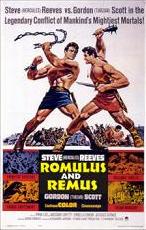
This stamp depicts the famous Capitoline statue of Romulus and Remus and their wolf-mom. These twin baby boys were sons of Mars, the god of war, and Rhea Silvia.  Rhea’s uncle, for complicated reasons, threw the babies into the Tiber River and imprisoned their mother.

Another version of the legend has Rhea Silvia thrown into the river with her boys and she becomes the wife of the river god. In any case, the boys bob around in the water for a while, get tossed ashore, and are found by a she-wolf. The lady wolf raises the twins until the proverbial shepherd comes along and takes over the task. The boys grow up and start to build their own city, but sibling rivalry rears its ugly head! Romulus has his own ideas about the way things should go, quarrels with Remus and kills him. Romulus names his city Rome.

One version of this foundation myth has Romulus and Remus as sons of Mars and Ilia, who was the daughter of our very own Aeneas and his newly-acquired ladylove, Lavinia. Does anyone besides me prefer Turnus to our Trojan prince?

Here’s Hollywood’s take on the story! Eeekkk! These ancient tales! Divine parentage, abandonment, exposure, feral children!

Today’s podcast is the final installment of The Aeneid. Enjoy!

Ancient World Now:The Aeneid

Click here for direct link to audio Episode #10.

Click here for previous episodes.

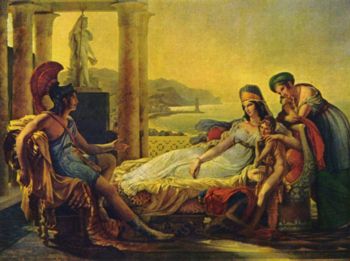
Queen Dido of Carthage. Dead. Built her own funeral pyre and as the flames whipped around her, plunged a dagger into her heart. So thoroughly had she humiliated herself for love of Aeneas, that she could no longer bear to go on. She cursed Aeneas and all of his descendants as she lay dying. Legend has it that her curse was the seed of hatred between Rome and Carthage that lead to the Punic Wars (264-146 B.C.E). Children in Rome were taught from an early age to hate the powerful north African state and all Roman children knew the Latin phrase “Carthago delenda est” or “Carthage must be destroyed”. When Rome finally did destroy Carthage, Roman soldiers were instructed to sow the land with salt so that nothing could grow there. Carthage was abandoned. Later, however, she was rebuilt and became a glorious and influential Roman colony. Some of the best preserved Roman mosaics and ruins are found in Carthage. And to think it all began with a mighty and righteous queen who had her heart broken by a no-good two-timing transient!

Another amazing story of Carthage might is that of Hannibal (no, not the psychopath) and his war elephants, but you have to listen to the podcast to find out! Enjoy!

Ancient World Now: The Odyssey

Click here for direct link to audio Episode #8.

Click here for previous episodes.

Narrowly averted a serious computer issue this morning. Fortunately, my amazing husband knows all the tricks and promptly set it right.

This episode is a wee-bit early, as I am off to the Society of Children’s Book Writers and Illustrators national convention. I am going with Peter Linenthal, who illustrated our storybook  The Golden Necklace: A Silk Road Tale. Check out his work by clicking on the “Ready-to-go-to-Press” tab at the top of this page. He does wonderful work and is one of the finest human beings I know. Fingers crossed that we locate a publisher this weekend for our beautiful book that needs a “home” (the topic of today’s podcast)!

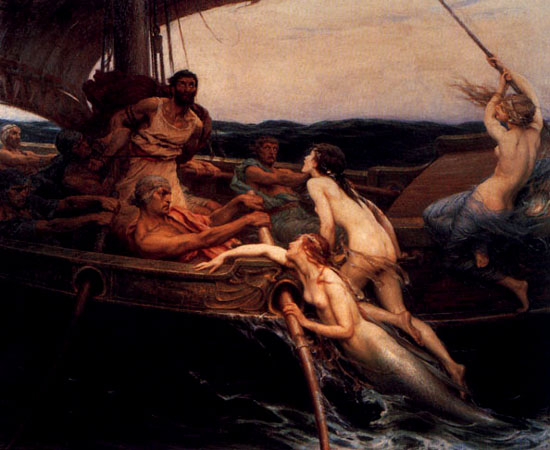
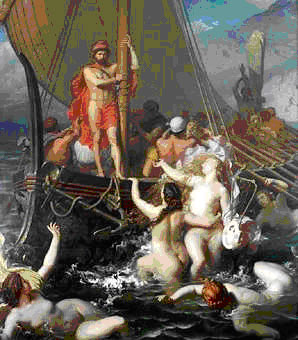
So…last week we met up with some sirens. Just to give you some idea of how their kind have been interpreted throughout the ages, I’ve included several cool pics. Here you see an ancient vase with flying bird-like creatures holding musical instruments. Great design! See the way Odysseus is tacked up to the mast.

Now take a look at these 19th century visions of sirens. Of course, they are wind-blown and fish-tailed and seem a whole lot more interested in the guys on the boat! Those artsy British men-of-leisure had an awful lot of time on their hands….

Today is the Homecoming of Odysseus. Oh, did I ruin the story for you? He does make it home, incredible as it may

seem, and puts a serious damper on the efforts of the suitors! Check out N.C. Wyeth’s painting below for proof. Enjoy!

Next week: The Aeneid, the story of Prince Aeneas’s back-door escape from the burning flames of Troy! Virgil wrote the epic at the request of Augustus Caesar to link the history of the people of Italy with the legendary heroes of old! Talk about revisionist history!

Ancient World Now: The Odyssey

Click here for direct link to audio Episode #7.

Click here for previous episodes.

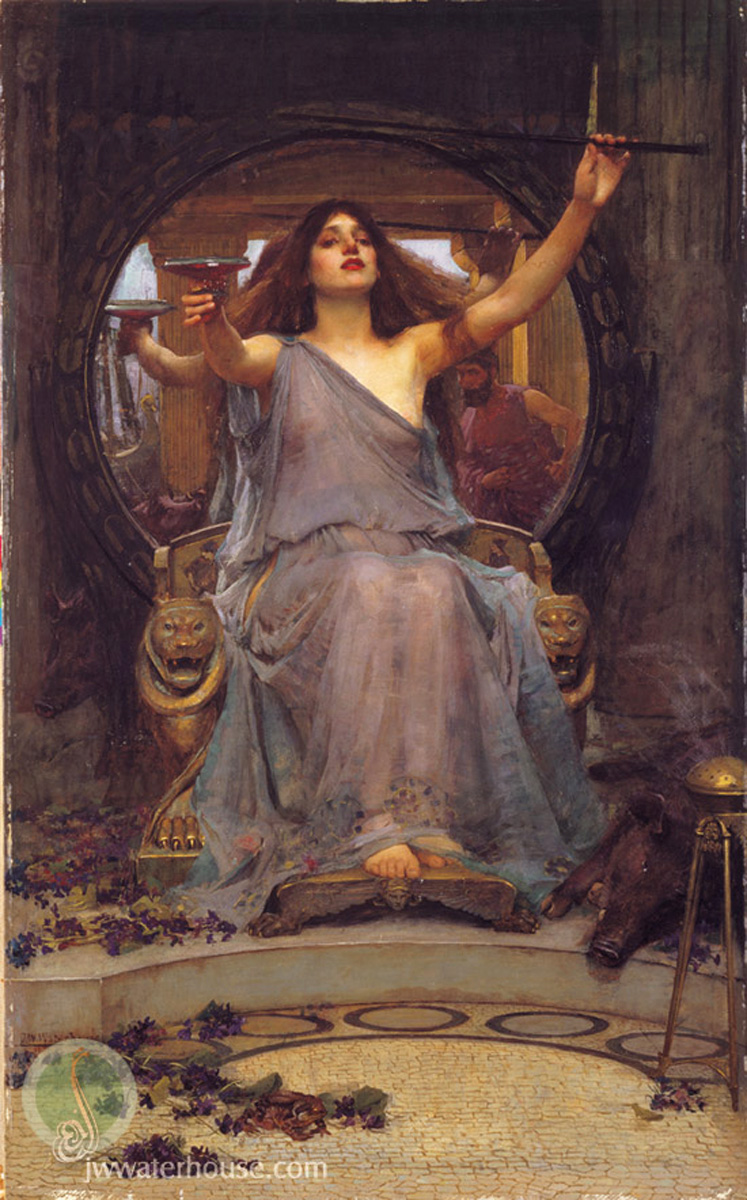
Circe the Sorceress….another painting by J.W.Waterhouse.

It turns out that Jason & Medea (another famous sorceress) visited Circe on their way back from the Black Sea where Jason was looking for that dazzling piece of finery we call The Golden Fleece. Medea worked all kinds of magic for the man she loved. She started killing people for his benefit quite early in their relationship. They stopped off to see Circe who purified them after they killed her brother. They washed up & got on their way. Later, Jason left Medea for a rich (and much younger) princess—so, Medea killed her in a very fiery, burning-flesh kind of way, and then hung up her little ones to dry, so to speak! She knew this would destroy Jason’s spirit! But that is a whole other story that I’d love to get into here, but hope that you will do a little research on your own and find out why Medea is not just famous, but infamous!

And, as usual, I get away from myself. So here is the powerful Circe, who actually does no harm whatsoever to our hero and his companions. And indeed, makes them all taller and more handsome than before. Oh yes, and younger.

Extra credit and a post here on the website to anyone who can paint, draw, or locate a fabulous image of Calypso. I have looked far & wide, but only found this one that just doesn’t do it for me. What fun you could have doing all the details of her magical garden. Or maybe someone could Photoshop this one & put some clothes on her!

Yikes!

Enjoy today’s installment of The Odyssey!

Ancient World Now: The Odyssey

Click here for direct link to audio Episode #6.

Click here for previous episodes.

You can now subscribe to my podcasts through itunes store!!!

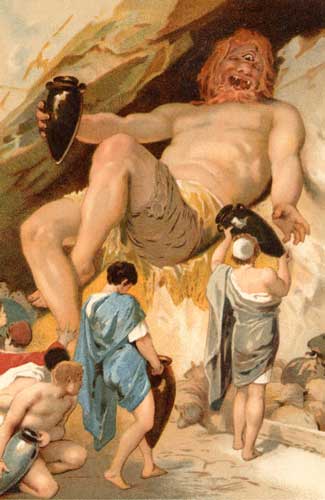
Of course, the favorite scene of kids everywhere and throughout the ages, I am sure. Polyphemus the cyclops, one-eyed son of Poseidon, eater of random strays & those washed ashore. Sheep-herder, island-dweller, boulder-thrower, non-drinker but open to it—and lover of Galatea, who did not love him. : (

I have a fondness for this guy. He really was just minding his own business, taking care of his sheep, hanging out in his man-cave. I think it is his role as “shepherd” that always made me feel such affection.  After getting him juiced up, clever Odysseus literally sticks it to him.

What happens to his animals? I’ve always wondered and worried about them….

Find out how the poor monster responds to our hero in today’s podcast. Enjoy!

Ancient World Now: The Odyssey

Click here for direct link to audio Episode #5.

Click here for previous episodes.

Today you meet Nausicaa, “of the white-arms”. One of my favorites. Referred to as “discreet”, you can see why. This young princess is down by the seashore playing ball & washing clothes, when her handmaids find a naked man washed up on the shore! Yikes! Her ladies try to stop her from going down to see what all the ruckus was about, but she insists—because she is Nausicaa, who knows her own mind. She treats him like any other stranger they might meet along the road, is absolutely unruffled and unmoved, and gets him a tunic & some refreshments from their mule cart. What a queen she will be!

In fact, it is known that Sophocles wrote a play about her. But, alas, as so many things from the ancient world, it is lost…..

I love Homer’s passages about this girl. This one in particular, when Odysseus first sees her and cannot tell whether she is mortal or goddess: “I have never with these eyes seen anything like you, neither man nor woman. Wonder takes me as I look on you. Yet in Delos once I saw such a thing, by Apollo’s altar. I saw the stalk of a young palm shooting up…And as, when I looked upon that tree, my heart admired it long, since such a tree had never yet sprung from the earth, so now, lady, I admire you and wonder, and am terribly afraid to clasp you by the knees.”
From Richmond Lattimore’s translation.

Enjoy the second installment of The Odyssey!

Ancient World Now: The Odyssey

Click here for direct link to audio Episode #4.

Click here for previous episodes.

Aaahhh, Penelope….. Waiting, waiting, waiting. Odysseus’s wife is one of the most memorable female characters in all of ancient story. This was one patient lass—she waited twenty years for her husband to return to her! Now that is faith. Penelope was hounded by suitors for years. Everyone was quite sure that Odysseus had been killed in the battle at Troy and that his lovely wife should take a new husband. Lone women surely can’t take care of themselves—and of course, she had all that property—a kingdom! Let’s get her married off to someone new. To keep these rascals at bay, she said she’d take a new husband when she finished weaving this burial shroud for her father-in-law, Laertes (no relation to Ophelia’s bro). Clever lass that she was, she’d weave by day and when the drunken suitors would nod off, she’d unravel at night. Dumb guys! You can see why Odysseus would choose her for a mate.

Here is John William Waterhouse’s painting of Penelope.  Waterhouse was at the tail-end of the Pre-Raphaelite school of painting, which focused on themes from the classical and Arthurian world….and some Shakespeare stuff, too. Edwardian. Victorian. You may know his painting of Proserpina (Persephone to the Greeks) with the pomegranate. Lots of rich details, deep colors, and dolorous looks! Fabulous!

Enjoy our first installment of The Odyssey!

Ancient World Now: The Iliad

Click here for direct link to audio Episode #3.

Click here for previous episodes.

Diomedes was one of the most revered heroes of the ancient world. Though we don’t hear much about him nowadays, he had as many adventures as Achilles and Odysseus! He is quite overshadowed by those other characters. But a huge chunk of The Iliad is devoted to his “aristeia”, or glory day on the battlefield, during which, he wounds Aphrodite, goddess of love.

This dramatic painting is by Arthur Heinrich Wilhelm Fitger and shows the mad chaos of Aphrodite’s desperate move to save her wounded son, Aeneas. And if you are a good student of the ancient world, you know that, yes, of course she saves him. Virgil’s Aeneid is the tale of Aeneas’s trials and tribulations after the Trojan War. Stay with me and you will hear my version of The Aeneid, soon to come as a podcast.

Next week we begin The Odyssey!!!